
Large Rorquals in Godbout

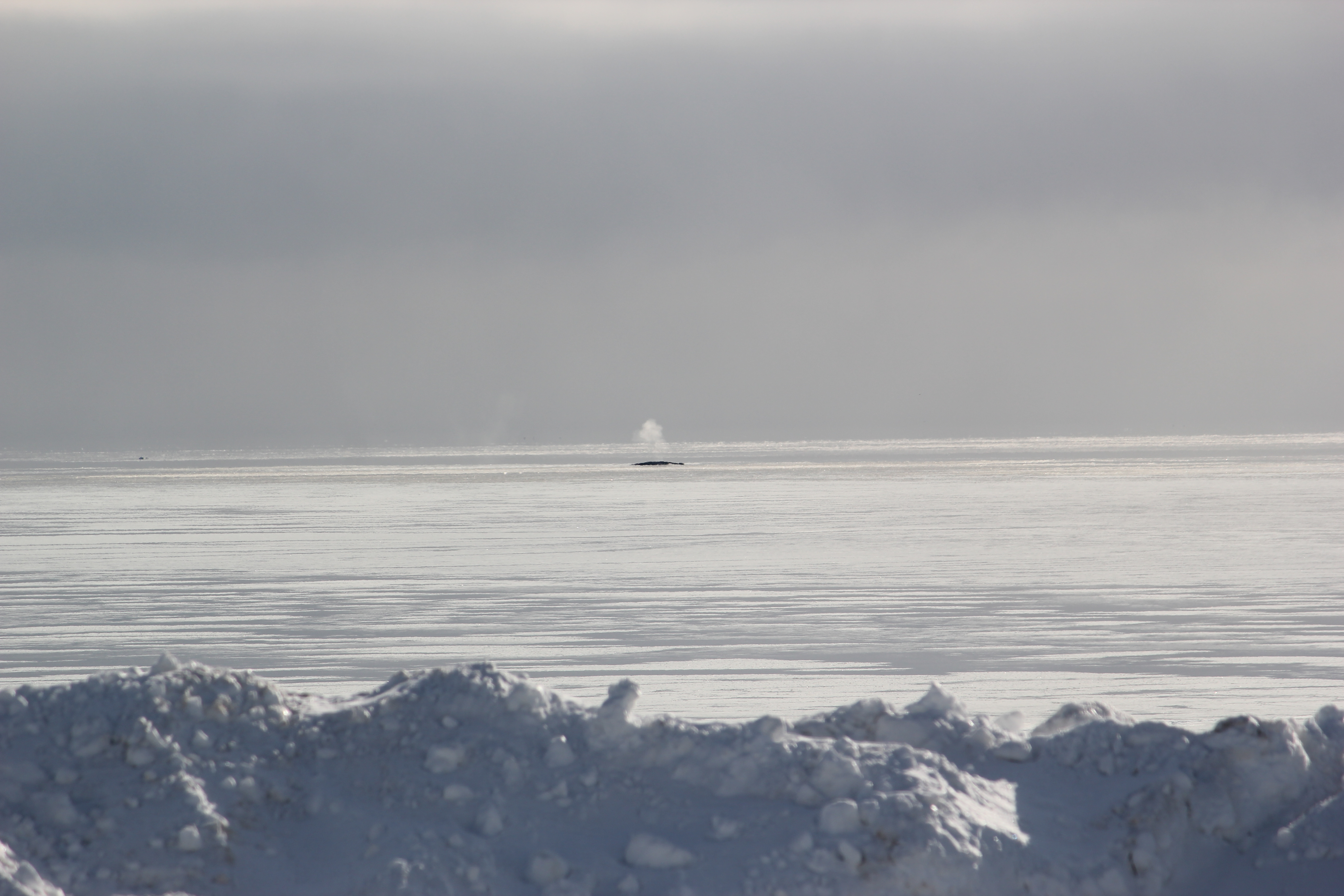
If you were pacing the shoreline in recent days in search of marine mammals, Godbout was the place to be! The impressive blow of a blue whale was spotted, as were the dark backs of other large rorquals whose exact identity remains a mystery. Seal sightings have been coming in from both sides of the St. Lawrence as drifting ice floes continue to wow locals.
Godbout: The place to be!
“This Friday morning in Godbout, I had the pleasure of observing my first large rorqual of the year,” shares one enthusiast. “On Saturday morning, the whale was back in front of my house and clearly visible to the naked eye. For an hour or so, it slowly swam around, diving now and again for a few minutes, before finally heading toward Pointe-des-Monts.”
The few photos taken to support the sighting reveal the animal’s immense size as well as its sizable spout. Did you know that the column of condensation produced by a blowing blue whale can reach up to six metres high? Which means it’s easy to spot from afar! In gusty conditions, however, it can be difficult to identify the species simply by its spout: The wind quickly disperses the droplets, thereby altering the shape and height of the plume.
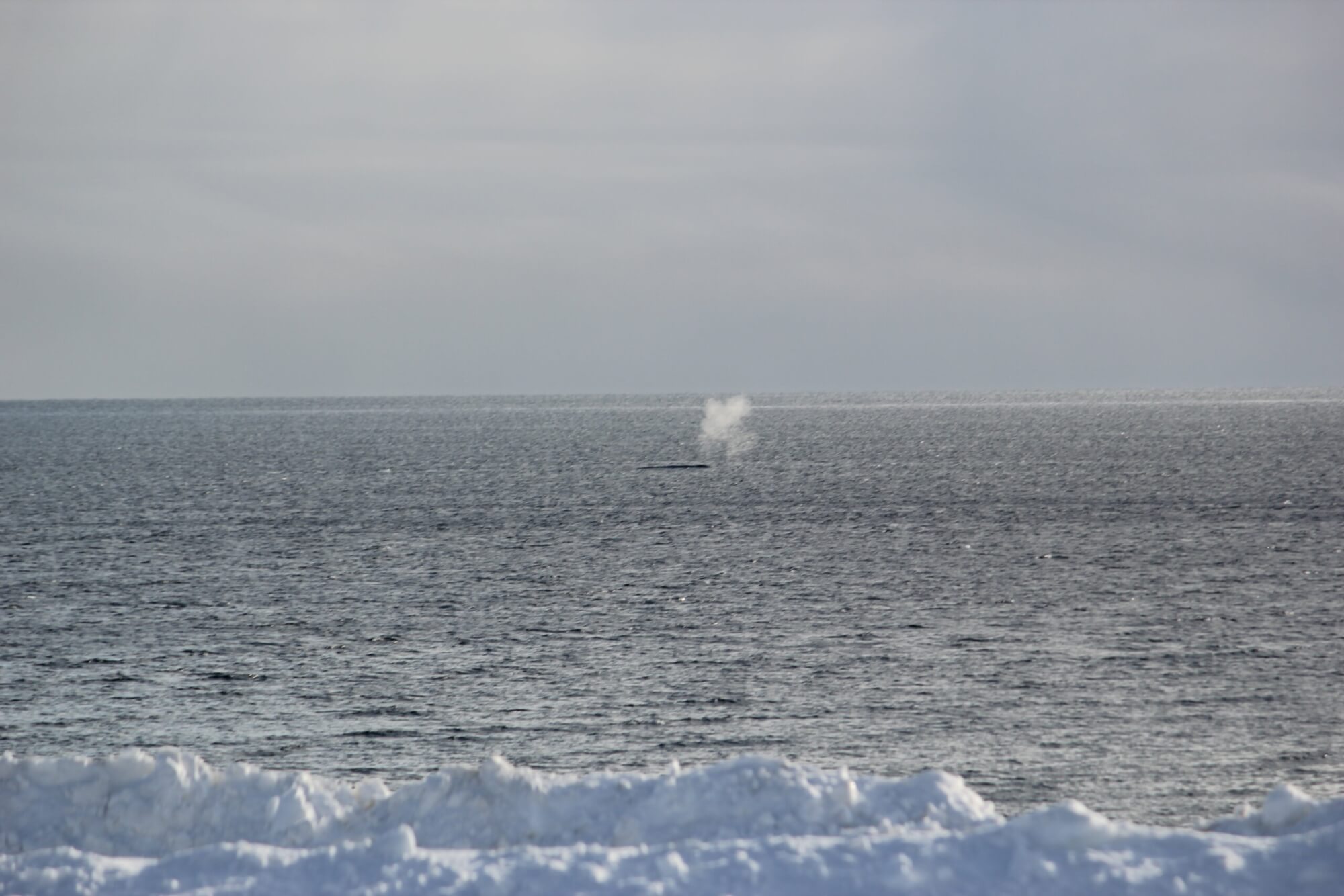
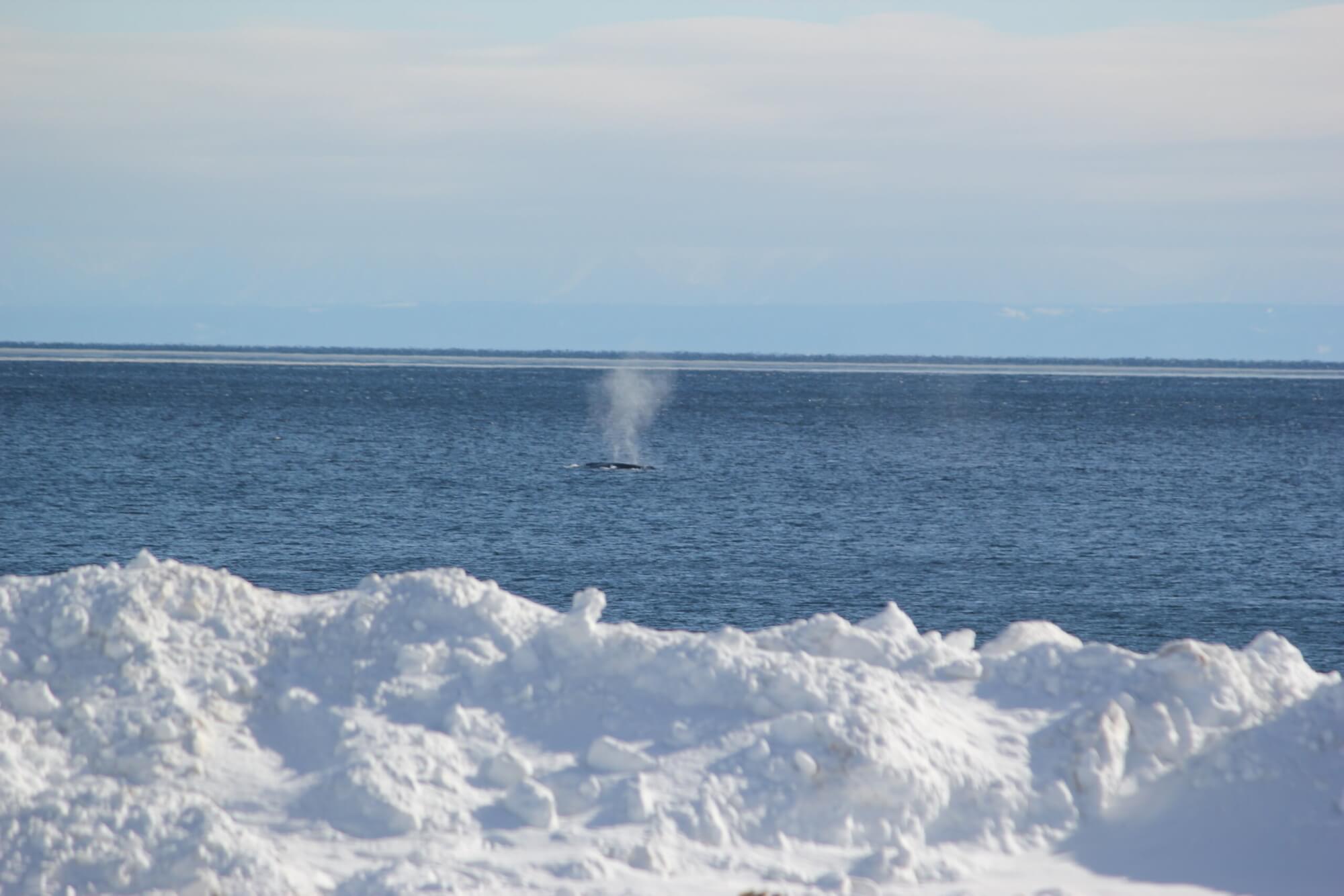
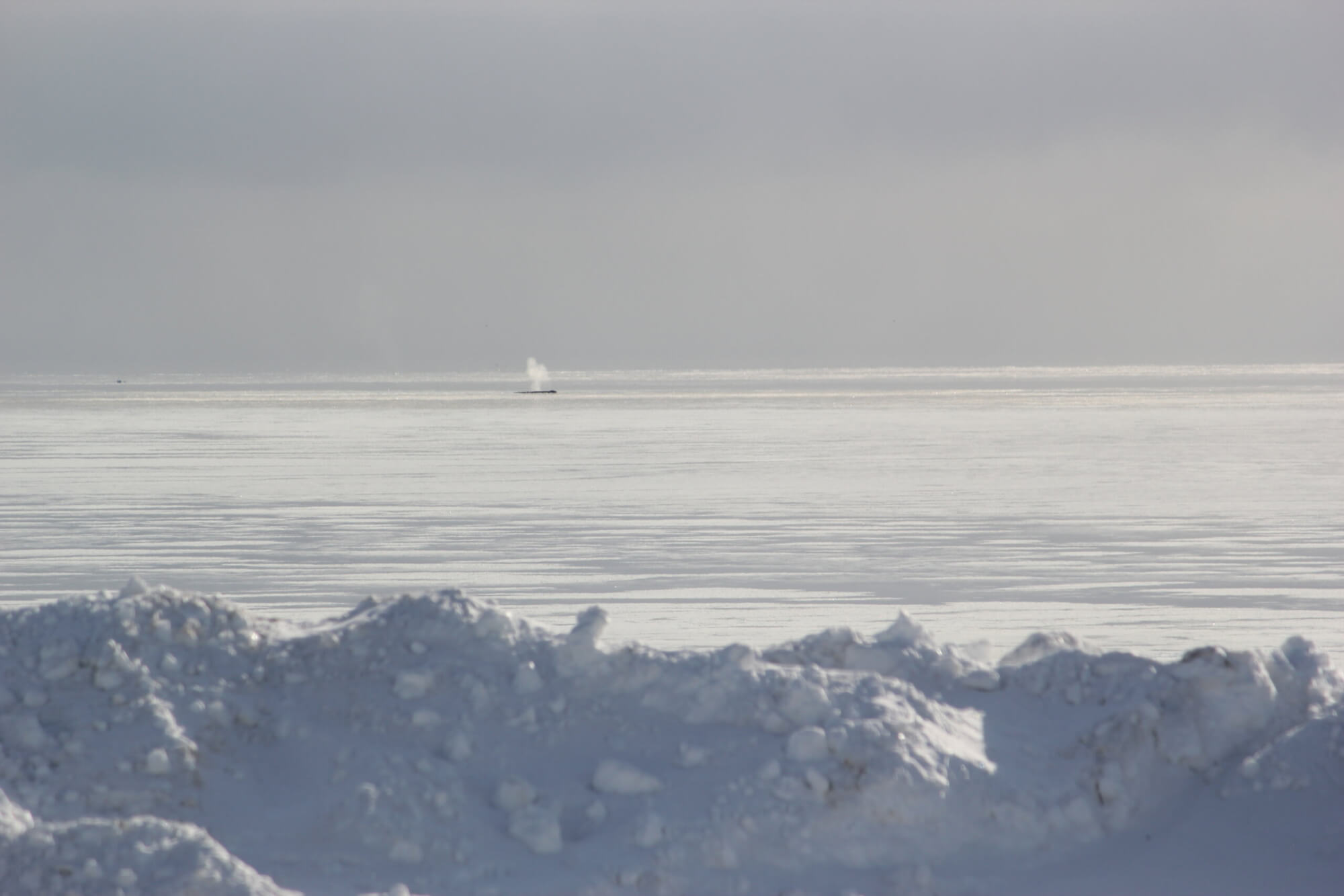
“Early Sunday morning, I saw two large whales, one much farther out to sea, and a second one in front of my house, closer to shore,” adds the lucky man, for whom the view from his home is almost magical.
One seal, two seals… fifty seals!
“On Saturday, February 14, while tallying seabirds in Penouille, we could make out the silhouettes of about 50 seals on the offshore ice in the direction of Sandy Beach and the Gaspé wharf, though I couldn’t identify the species,” reports an observer live from the Gaspé Peninsula. A certain presence of pinnipeds is also noted along the estuary, particularly near Les Bergeronnes. A seal was also basking on the ice floes between Baie-Comeau and Matane.
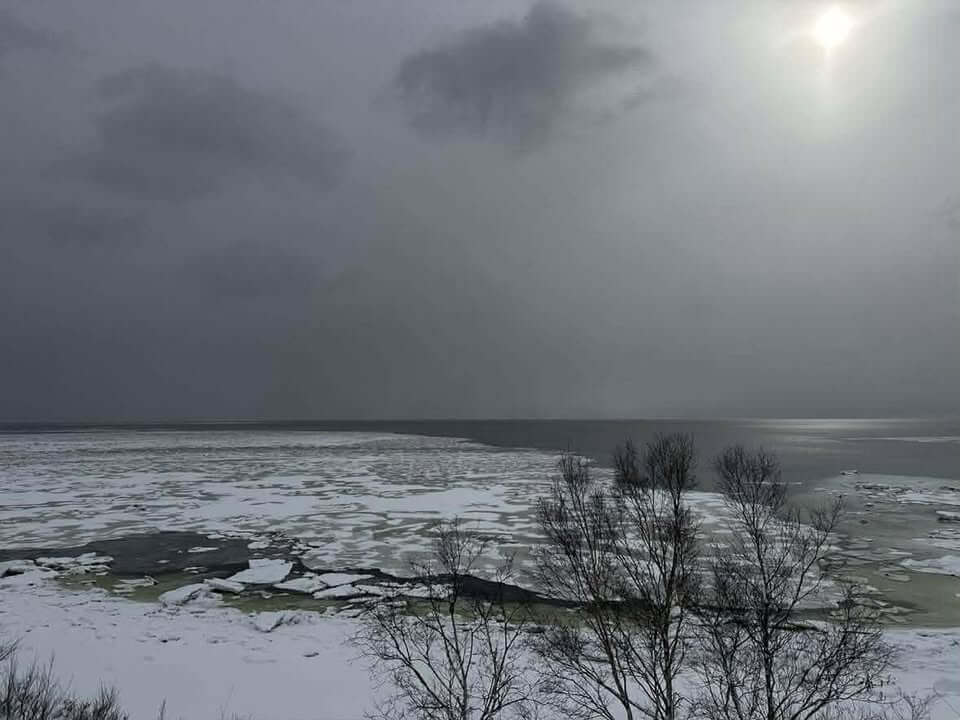
While ice is important for seals, it remains an obstacle for certain cetaceans, including fin whales. Large rorquals do not have the same adaptations as Arctic species such as belugas. The latter have a dorsal ridge—rather than a dorsal fin—which allows them to break through the ice when they surface to breathe. Large rorquals generally need to be able to move in ice-free waters. In 2014, a group of nine blue whales found themselves trapped in ice off the coast of Newfoundland.
Though they don’t count as marine mammals, icebergs are nevertheless fascinating for observers. Their relative abundance this winter provides a resting spot for seals, not to mention something to admire for those taking a stroll along the St. Lawrence. Be careful not to confuse them with the white backs of belugas as they drift through the frigid waters!
Thanks to all our collaborators!
Special thanks go out to all our observers who share their love for marine mammals with us.
Your encounters with cetaceans and pinnipeds are always a pleasure to read and discover. On the water or from shore, it is your eyes that give life to this column.
- Laetitia Desbordes
- Hélène Guitton
- Diane Ostiguy
- Andréanne Sylvain
- Ophélie Turgeon
- Marielle Vanasse
- J. Varin
And all the others!
Additionally, we would like to acknowledge the following teams that also share their sightings:
Centre d’éducation et de recherche de Sept-Îles (CERSI)
Station de recherche des Îles Mingan (MICS)
Réseau d’observation des mammifères marins (ROMM)
Réseau québécois d’urgence pour les mammifères marins (RQUMM)
Groupe de recherche et d’éducation sur les mammifères marins (GREMM)
Mériscope
Would you also like to share your observations? Have you seen any marine mammals in the St. Lawrence? Whether it’s a spout offshore or just a couple of seals, drop us a line and send your photos to [email protected]!

Odélie Brouillette
Odélie Brouillette joined the GREMM team as a writer and naturalist in 2022, and has been a project manager in science popularization since 2023. With a background in biology, she loves learning and sharing with others what's most important to her. She has always been fascinated by marine environments and whales, and hopes to contribute to their protection through awareness-raising and popularization.
Recommended articles
The Calm Before the Whales
Despite the snow, the wind, and the bitter cold of the past few days, several belugas were spotted off the…
Marine Mammals, from the St. Lawrence to the Caribbean
Seals on the ice floes in the estuary, a blowing blue whale near Baie-Comeau, and a humpback identified in the…
Belugas in the Estuary and Pinnipeds Aplenty
It’s early February, and the sunlight pierces through the cloudless Tadoussac sky. From the windows of the Whales Online office,…