
Surface Feeding and Seals on the Ice Floes

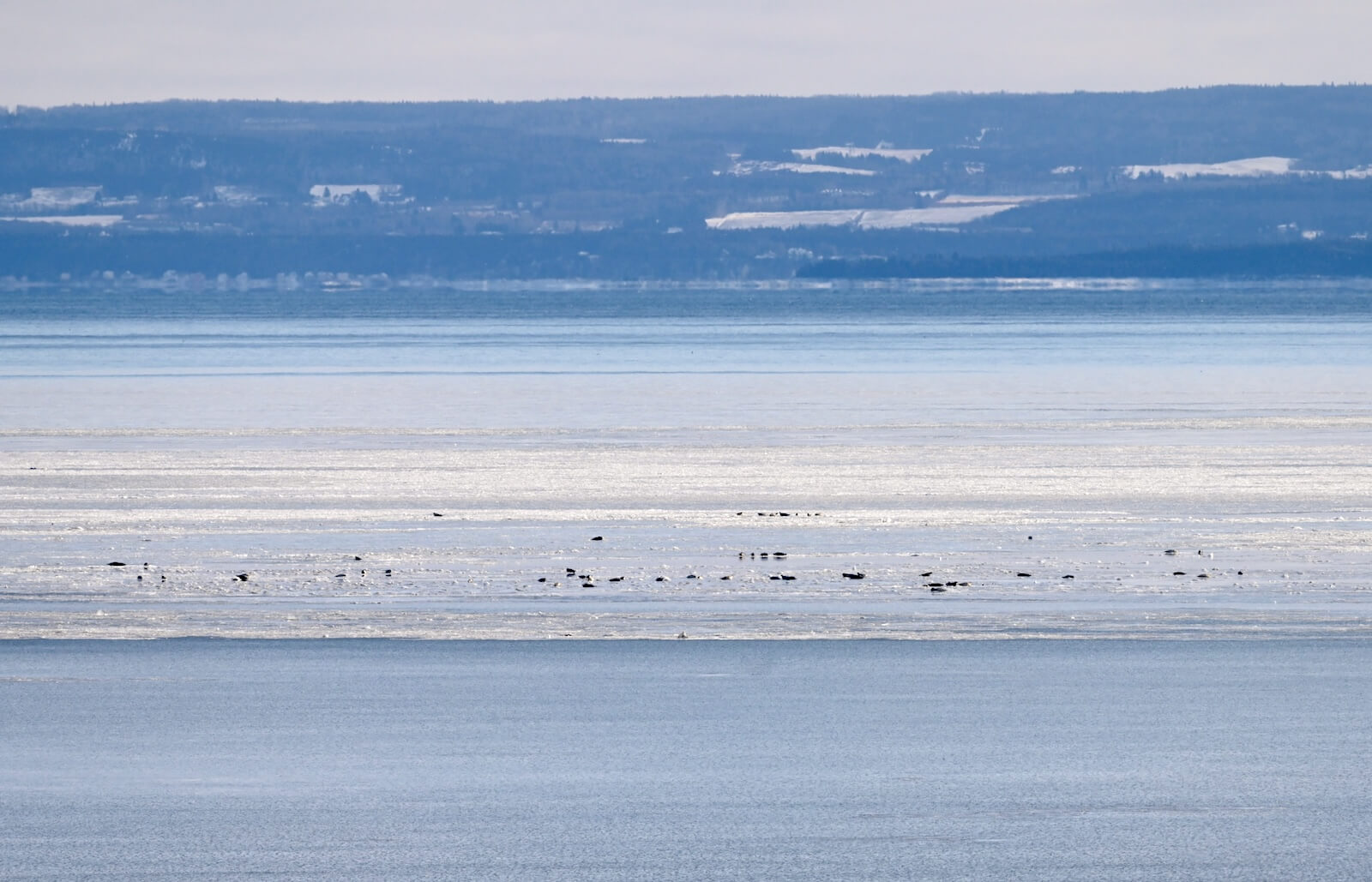
Whale watching in the St. Lawrence has gotten off to a quiet start in 2026… except between Franquelin and Baie-Comeau, where several fin whales were spotted surface feeding! Elsewhere along the coast and farther offshore, the brave souls who ventured out into the January cold managed to observe a few seals and belugas here and there. Have the large marine mammals already returned to the more temperate waters of the South?
Seals and snow
“In Franquelin on December 20, a group of harp seals appeared near the shore, but with the falling snow, it wasn’t long before I lost sight of them!” shares a resident of Baie-Comeau.
In the Saguenay–St. Lawrence Marine Park area, harp seals continue to be the talk of the town. According to one naturalist and wildlife photographer, over one hundred individuals were reportedly observed drifting offshore on the sea ice between Christmas and New Year’s Day. He also noted the presence of several belugas in the mouth of the Saguenay Fjord on January 6, their white backs blending in with the passing ice floes. In Saint-Siméon, a seal was swimming near the wharf, where it appeared to be feeding.
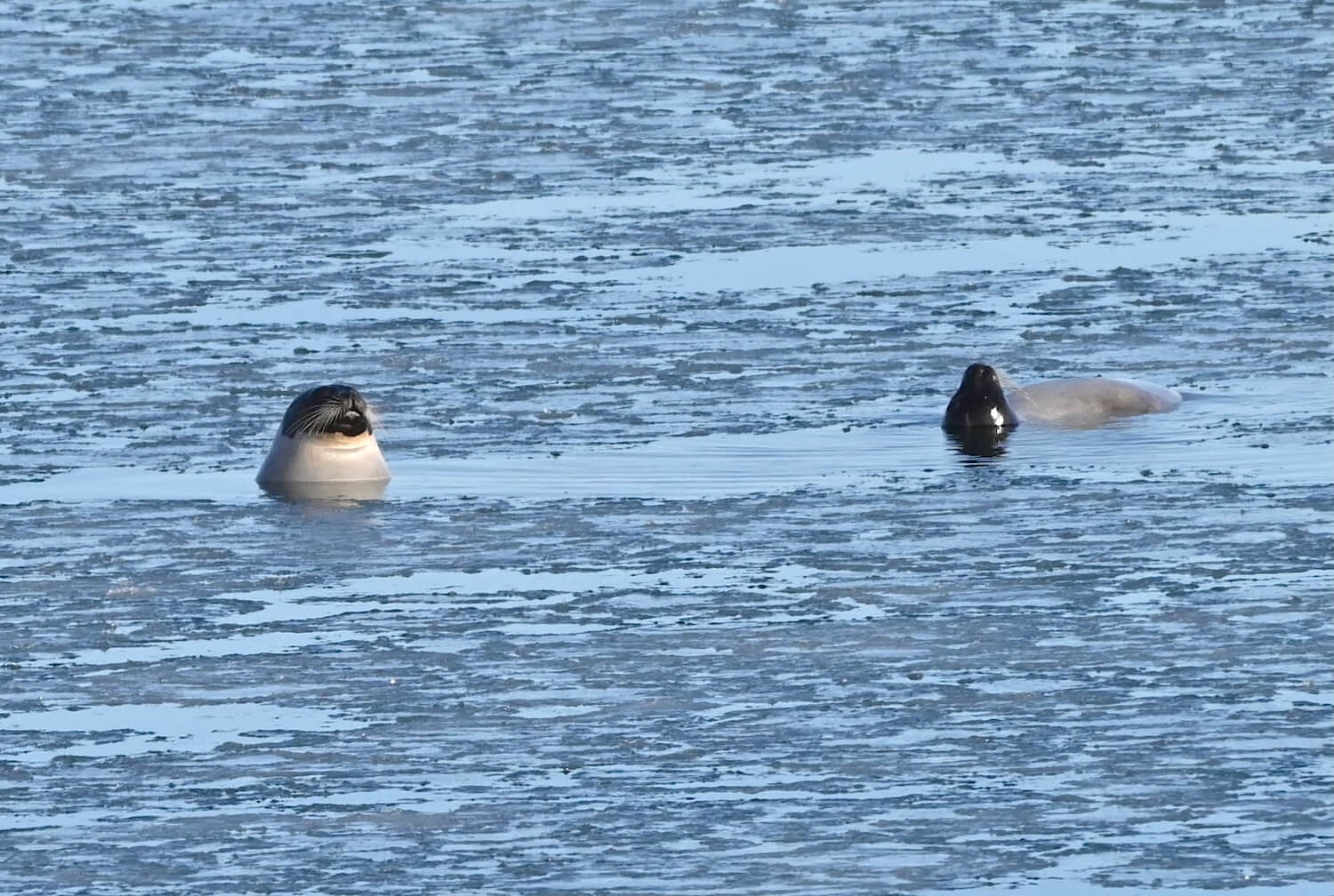
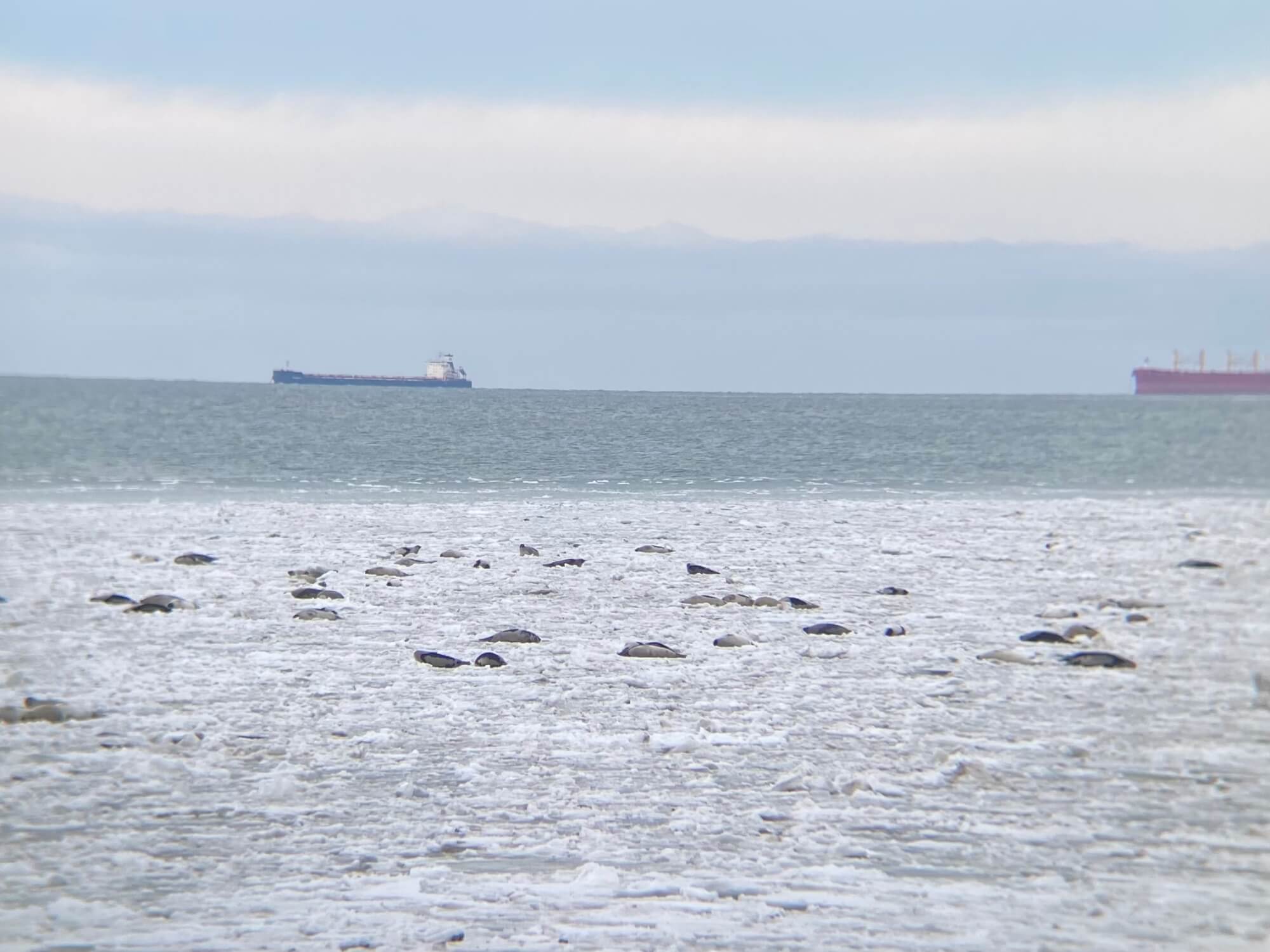

Hundreds of harp seals were also basking on the sea ice in the vicinity of Gaspé Bay earlier this month, but were no longer there in recent days, explains one local resident. On the same shore but farther west, one of our subscribers shares a strange coincidence that occurred during her observation a few days before Christmas: “On the road known as Chemin des Loups-Marins [Translator’s note: harp seals are sometimes referred to in French as loup-marins] at the western end of Saint-Simon-de-Rimouski […], I tallied over 300 of them on the ice, spread across a distance of about 5 km.”
Importance of sea ice
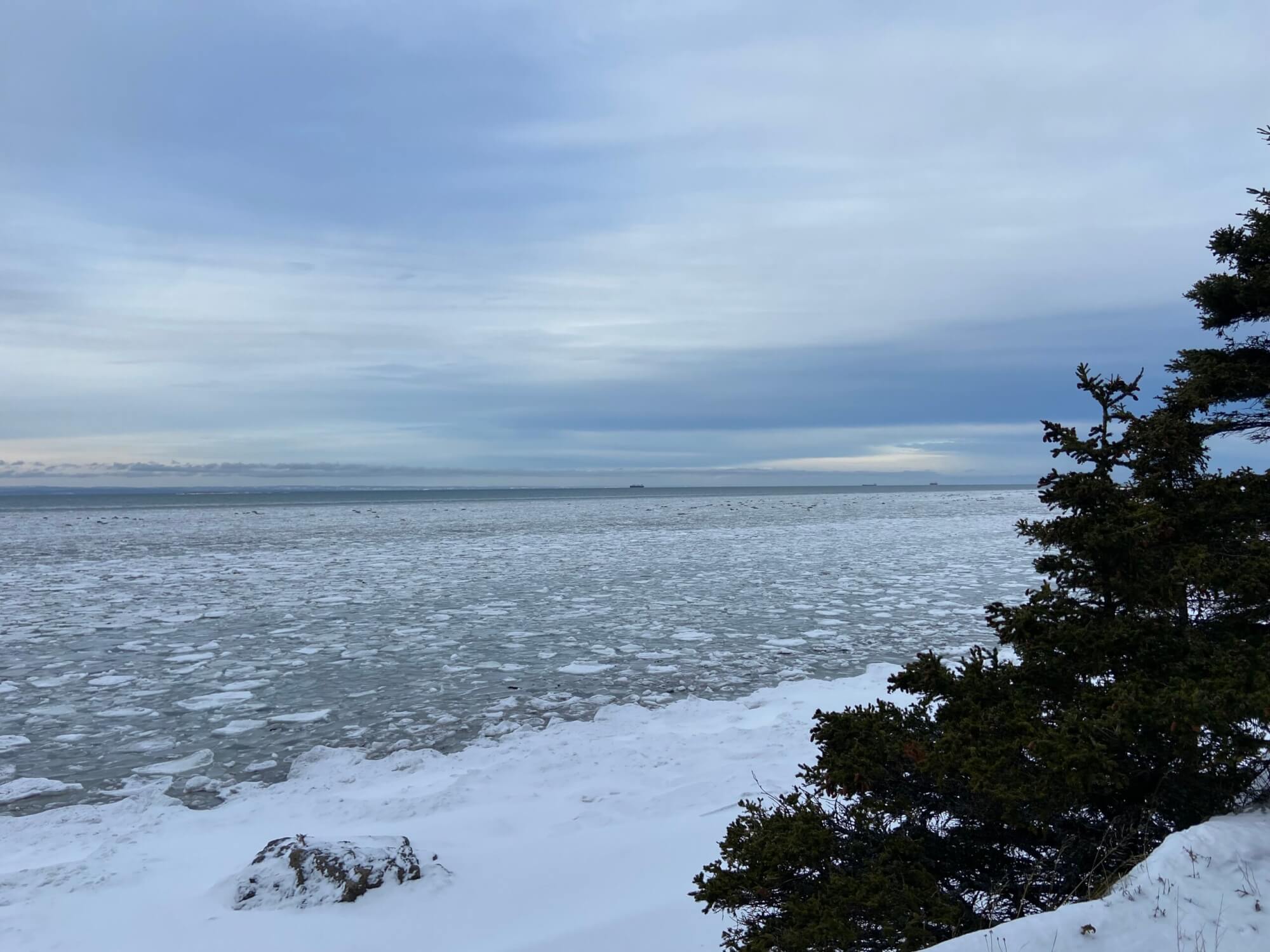
Ice is of critical importance for the survival of the harp seal. The species depends on ice not only to rest, but also to moult and to give birth to its pups. Due to the changing climate, ice cover on the St. Lawrence tends to fluctuate unpredictably. So far this year, ice cover appears to be only slightly below normal, a phenomenon that has not been observed since 2020, according to a recent Radio-Canada article. Peter Galbraith, a physical oceanographer at the Maurice Lamontagne Institute, explains that ice forms when temperatures fall well below zero. Milder weather tends to postpone or even prevent ice formation altogether. For harp seals, this unpredictability forces them onto land, where they are more vulnerable to threats, reducing their offspring’s chances of survival.
Three fin whales and two blues
Between Franquelin and Baie-Comeau, observers were definitely not disappointed! “It was crazy, it was like a fin whale festival, they were feeding at the surface […], I was ecstatic!” exclaims a seasoned observer from the region. Indeed, three fin whales and two blue whales were feeding with their mouths wide open, undoubtedly feasting on tiny crustaceans in the area. Physically demanding, this technique allows the blue whale to gulp down an estimated 90 tonnes of water – the equivalent of its own weight! Then, by filtering the water through its baleen plates, the animal manages to keep only the krill in its mouth.
Elsewhere in the St. Lawrence, large whales have been conspicuous… by their absence. This time of year, they are most likely en route back to their breeding and calving grounds in the Caribbean. The few individuals still lingering in Canadian waters have surely found enough to eat!
Thanks to all our collaborators!
Special thanks go out to all our observers who share their love for marine mammals with us. Your encounters with cetaceans and pinnipeds are always a pleasure to read and discover.
On the water or from shore, it is your eyes that give life to this column.
- Laetitia Desbordes
- Diane Ostiguy
- Pascal Pitre
- Renaud Pintiaux
- Céline Riou
- Andréanne Sylvain
And all the others!
Additionally, we would like to acknowledge the following teams that also share their sightings:
Centre d’éducation et de recherche de Sept-Îles (CERSI)
Station de recherche des Îles Mingan (MICS)
Réseau d’observation des mammifères marins (ROMM)
Réseau québécois d’urgence pour les mammifères marins (RQUMM)
Groupe de recherche et d’éducation sur les mammifères marins (GREMM)
Mériscope
Would you also like to share your observations?
Have you seen any marine mammals in the St. Lawrence? Whether it’s a spout offshore or just a couple of seals, drop us a line and send your photos to [email protected]!

Odélie Brouillette
Odélie Brouillette joined the GREMM team as a writer and naturalist in 2022, and has been a project manager in science popularization since 2023. With a background in biology, she loves learning and sharing with others what's most important to her. She has always been fascinated by marine environments and whales, and hopes to contribute to their protection through awareness-raising and popularization.
Recommended articles
The Calm Before the Whales
Despite the snow, the wind, and the bitter cold of the past few days, several belugas were spotted off the…
Marine Mammals, from the St. Lawrence to the Caribbean
Seals on the ice floes in the estuary, a blowing blue whale near Baie-Comeau, and a humpback identified in the…
Large Rorquals in Godbout
If you were pacing the shoreline in recent days in search of marine mammals, Godbout was the place to be!…