
Why do certain species of seal swim on their backs?

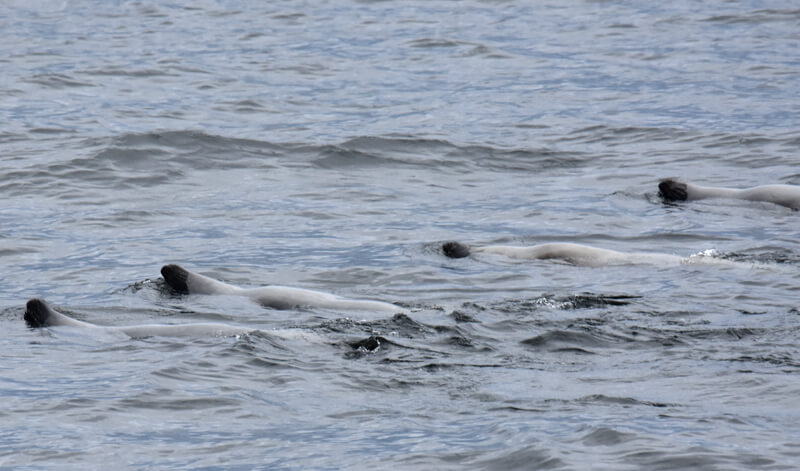
In a video captured by drones operated by researchers at the Mingan Islands Research Station (MICS), dozens of small white silhouettes stand out against the blue backdrop of the sea. Is this a pod of belugas? Upon closer inspection, however, it becomes clear that these animals seem faster and more active than belugas. That’s because they’re harp seals! They swim on their backs, revealing their white bellies.
While other seal species are occasionally seen rolling over or floating on their backs, only the harp seal consistently adopts this position. Does it serve a specific purpose? Scientists cannot yet answer this question with certainty.
Upside Down
“What’s certain,” says Mike Hammill, a researcher with Fisheries and Oceans Canada and a seal specialist, “is that swimming on their backs gives them a better view of what’s happening below them.” In this position, the harp seal submerges its head completely. Its eyes, located on top of its head, are thus turned toward the depths rather than toward the sky.
And seeing in a dark, murky marine world is no problem for it, since it has vision adapted to this environment. Underwater, its pupils dilate as much as possible to capture as much light as possible. Its eyes are also equipped with photoreceptors sensitive to black, white, or gray pigments, which are more prevalent underwater. As a result, it probably sees much better in the sea than on land! But what exactly is it watching for?

Monitoring by Scanning
It all depends on the season. In winter, from late February to mid-March, the harp seal is in its breeding season in the St. Lawrence River. Like many other seal species, they mate in the water. They are therefore particularly vulnerable and must remain alert to any activity that could harm them (disturbance, threats) or benefit them (food). Since females can give birth to only one pup per year, their reproductive success is particularly important.
In the summer, the harp seal migrates to the waters of the Canadian Arctic or Greenland. In these regions, monitoring the marine environment is even more critical than in the St. Lawrence River due to certain predators lurking there: killer whales, sharks, or even walruses, depending on the location. “Most of these predators could emerge from the depths, so keeping an eye on what’s below is more important than watching what’s happening above,” says Mike Hammill. However, the researcher notes that swimming on its back could potentially put the harp seal at a disadvantage when facing a land-based predator such as the polar bear, which tends to emerge from the sea ice.
This behavior will need to be studied in greater depth to understand what drives the harp seal to scan the seafloor, or how this posture affects its swimming. Certainly, this characteristic makes the seal easier to distinguish from other pinniped species found in the St. Lawrence Estuary. Or, at times, it makes it easier to mistake it for a beluga when viewed from the sky!


Gabrielle Morin
Gabrielle Morin joined the Whales Online team as an intern in early 2020. As a student of literature, she is involved in Québec City’s literary community and writes in her spare time. Gabrielle’s love of whales was born on the shores of the St. Lawrence Estuary and remains with her in Lévis, where she resides. Since then, she has nourished this passion through scientific literature and summer expeditions. She believes that her passion for literature and marine mammals is rooted in the same desire: to capture and especially to share her sense of wonder.
Recommended articles
Your questions about beluga reproduction!
The Whale Watch team and the team of naturalists at the Marine Mammal Interpretation Centre (CIMM) regularly receive questions about…
Why did so many large rorquals visit the St. Lawrence this spring?
Early 2025 was a particularly intense period for observing large rorquals in the Saguenay–St. Lawrence Marine Park. Whether it be…
A Smirk with a Purpose!
Belugas are known for their expressive faces, but what’s behind their endearing smirk? From an “O”-shaped mouth to water spitting…