
Bp935
Fin Whale

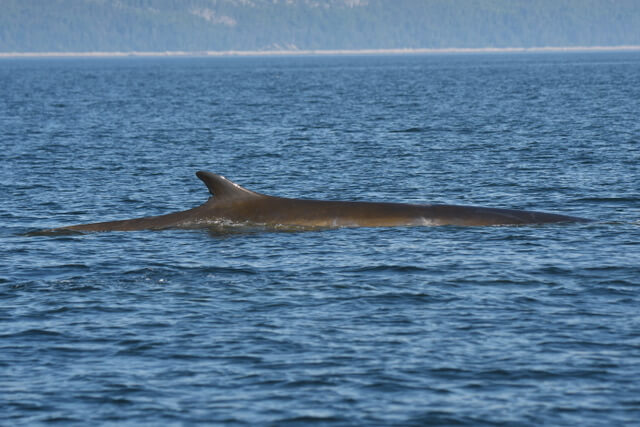
-
ID number
Bp935
-
Sex
Male
-
Year of birth
Winter 2006-2007
-
Known Since
2007
Distinctive traits
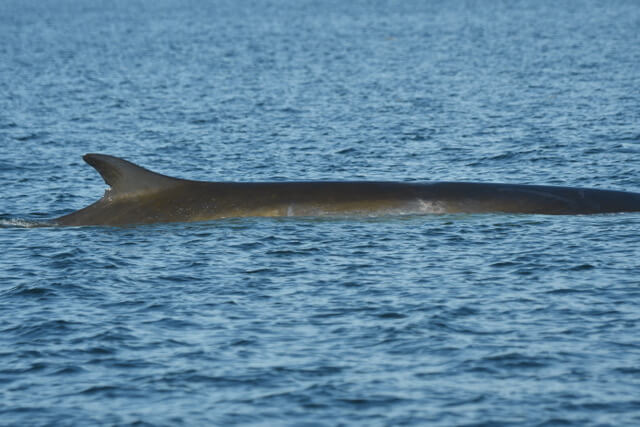
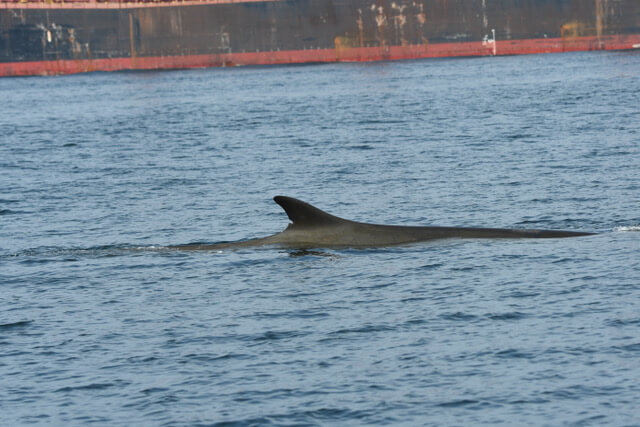
White mark on right flank; dorsal fin presents a notch at its base and a slight change in angle in its curve.
Life history
The fin whale Bp935 first arrived in the St. Lawrence Estuary in the summer of 2007, along with its mother, the famous Capitaine Crochet (“Captain Hook” in French). A true star of the Marine Park, Capitaine Crochet will long be remembered for her punctuality, fidelity and fertility. Between the time she was first identified in 1994 and her tragic entanglement and disappearance in 2013, this female fin whale was sighted nearly every summer in the Estuary, and was often one of the first of her species to arrive. She is credited for giving birth to at least three calves, including the famous Bp955 a.k.a. “Ti-Croche”, born in 2009 and who would therefore be Bp935’s younger brother or sister.
Despite this family heritage connected to the Estuary, Bp935 was not seen in the St. Lawrence for 12 years before being identified again in 2019, and then again in 2020. Where had it gone in the meantime? That’s anyone’s guess! The migrations of fin whales are still poorly understood. But the years have left their mark on Bp935’s skin: its dorsal fin now shows a large notch in its trailing edge, and, in 2020, a scar was discovered on its right flank which was not there last year. After so many years and changes, it was ultimately Bp935’s chevrons and the patterns on its peduncle that allowed researchers to recognize it.
Observations history in the Estuary
Years in which the animal was not observed Years in which the animal was observed
Latest news from the publications Portrait de baleines
It is well known that the famous fin whale Ti-Croche (Bp955) is the offspring of Capitaine Crochet (Bp050). But did you know that Bp935 is also a descendant of this famous female? Born in the winter of 2006–2007, Bp935 arrived in the St. Lawrence Estuary in the summer months that followed, accompanied by his mother. Twelve years then passed before this individual reappeared in the area, in 2019. It is still unknown which regions he frequented during this long period of absence. Spotted in mid-July, Bp935 is therefore only in his seventh year in the estuary. Interestingly, Ti-Croche and her older brother Bp935 were observed swimming nearby on the day he arrived! Family relationships among whales are complex to study. It is especially during the first few months of a calf’s life, while it is still with its mother, that it is easiest to establish a connection between individuals. In the case of Bp935, it was the regular sightings with Capitaine Crochet that made it possible to determine that he was indeed her calf. Female fin whales can nurse their calves for up to seven months. Since births generally occur during the winter, the mother may still be by the calf’s side when it passes through the St. Lawrence, as was the case with Bp935 and Capitaine Crochet in 2007. In fact, it was during this first passage through the estuary that a biopsy was taken from Bp935, confirming that he is a male!