
Crystal Clear Waters

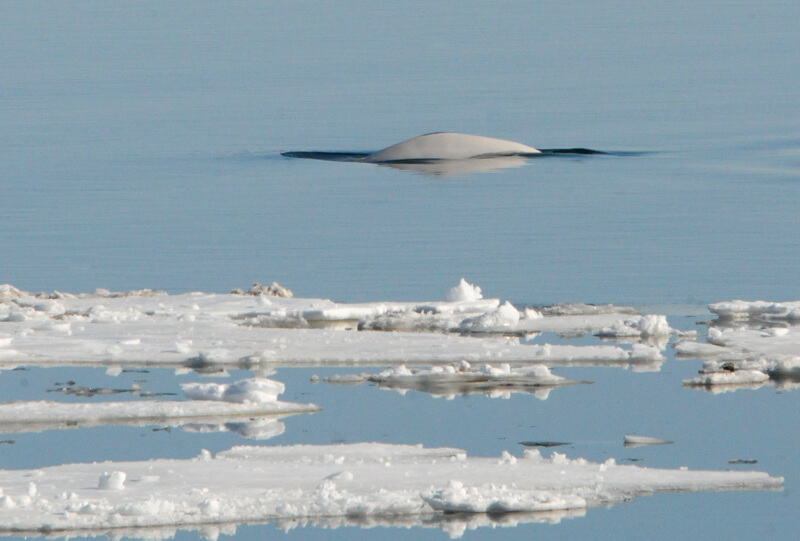
Cetaceans in sight for the first time weeks! On February 25, it was from the docks in Les Escoumins that a local resident saw little white spots amidst the big chunks of ice in the Estuary. Yes indeed, it’s a small group of belugas! Most of these ‘sea canaries’ spend the winter at the mouth of the Gulf of St. Lawrence, where ice is less abundant. However, it is not unusual for some individuals to deviate from this rule and wander farther upstream.
Not far from there are also dozens of harbour seals, according to local captains. “There are several along the shoreline! Many have been venturing into the Baie des Escoumins,” they report. On the other side of the river, in the Gaspé Peninsula, a resident has also been seeing a handful of harbour seals every day in Gaspé Bay. A number of observers have noted that the ice is abundant and thick this year. This is beneficial to those species of seals that frequent Quebec waters, since many of them rely on it to rest and dry off between periods of feeding, as well as to give birth.
Below the ice
The Côte-Nord region is still besieged by arctic weather, and the St. Lawrence continues to sport its immaculate white coat. At Longue-Pointe-de-Mingan, the pack ice extends to the horizon. Between sky and sea, it’s dead calm: not a single pinniped to be seen, and the breaths of cetaceans are still absent. But if you take a peek below the ice, you may see something unique to this bitter season! “In winter, there are no large phytoplankton blooms in the St. Lawrence, so instead of being green and opaque, the water is crystal blue!” says mariner Jacques Gélineau after a chilly dive. “It’s quite beautiful to see,” he continues.
Indeed, the presence of ice considerably reduces the luminosity in certain regions of the river during the winter. Combined with extremely low temperatures, this prevents phytoplankton from thriving as well as it does during the warmer months of the year. However, it does survive these harsher conditions and even manages to grow a little.
Check out this eye candy in this video!
Have you seen a seal or a whale?
Share your observations and photos by writing to us at [email protected] or on our Facebook page.

Elisabeth Guillet Beaulieu
Elisabeth Guillet-Beaulieu joined GREMM’s scientific editorial team in the early fall of 2021. Her boundless love for marine biology and aquatic environments from a young age ultimately led her to pursue a career in science. With a bachelor’s degree in biology, this nature and conservation enthusiast joined the Whales Online team in the hope of sharing her contagious passion for marine mammals while completing her master’s in the environment and sustainable development.
Recommended articles
Wrapping Up the Season with Some Thanksgiving Weekend Action!
This year’s Thanksgiving weekend was alive with the activity of whales, seals, and birds! Marine mammals are still lingering in…
Between Bronze and Anthracite
Yellow-orange hues reaching toward the sky blend with the smooth, dark swirls emerging from the waves. Even if the strong…
Waters Stirred by Blowing Whales
The shores of the St. Lawrence are ablaze with orange and golden foliage. These multicoloured hues are reflected in the…