
A Rigorous Protocol for Studying Large Rorquals

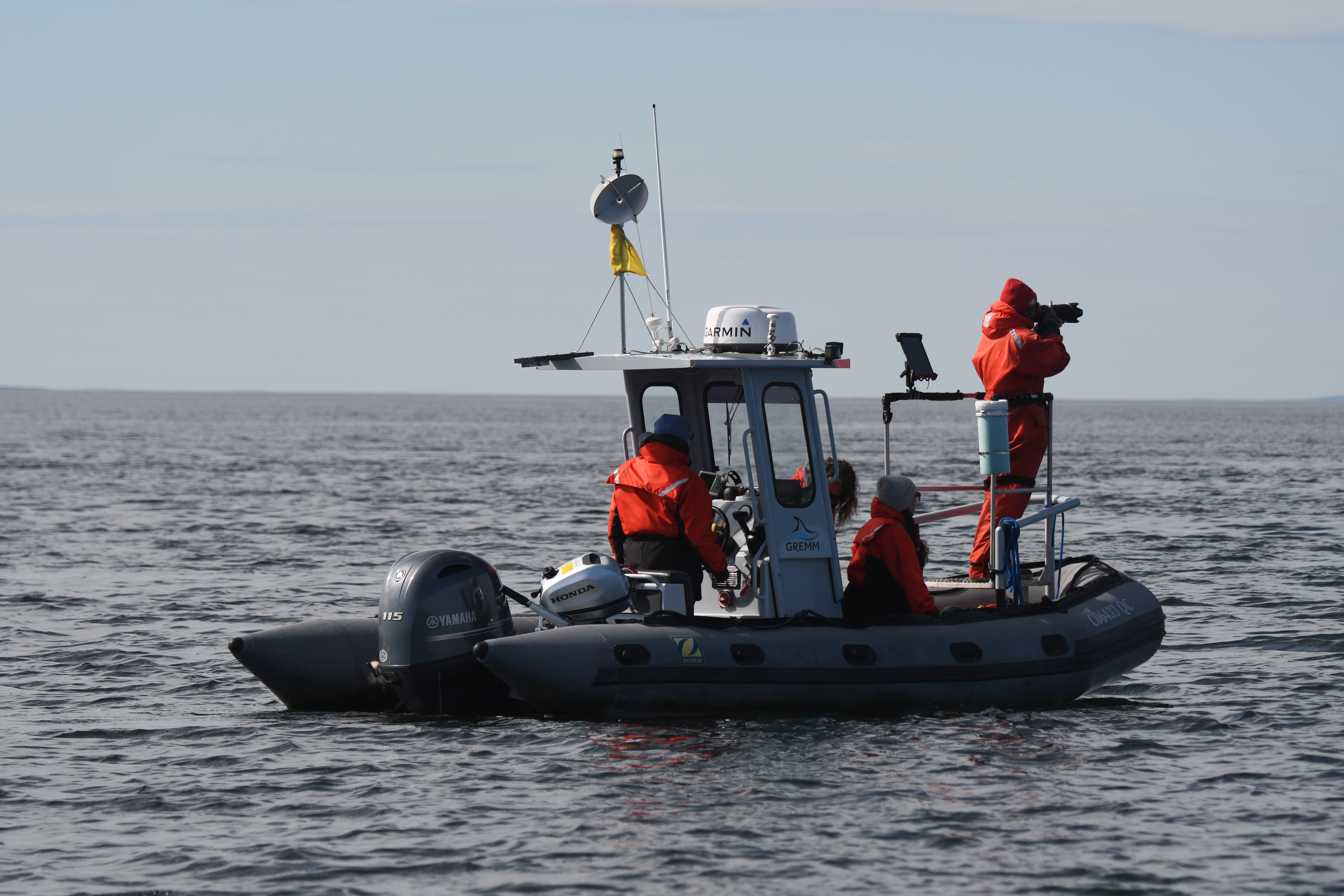
Aboard the BpJAM (one of GREMM’s research vessels) with the Large Rorqual Project team, I scan the horizon in the hope of catching a glimpse of a spout or a dorsal fin. The dazzling sun and the small waves sometimes obscure our vision. Ten minutes go by, there’s nothing to report, and we set off again.
Stretching nearly 25 km wide in places, the St. Lawrence Estuary is a vast expanse of water for research teams to navigate. How do they find their way around? And above all: How do they spot large rorquals, these gigantic creatures that sometimes manage to elude scientists? The answer can be summed up in just four words: by following a protocol!
Long-term monitoring of large rorquals
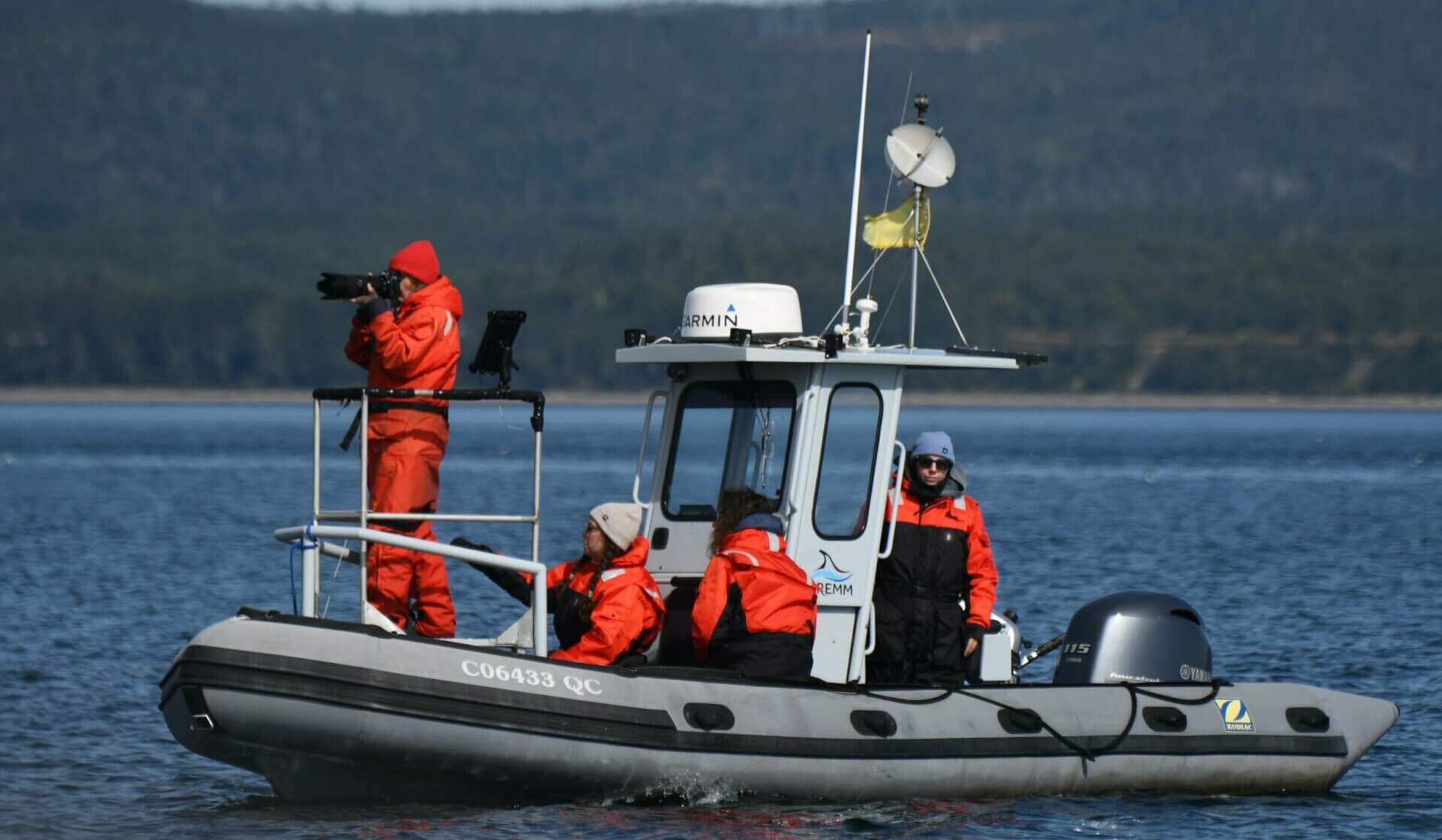
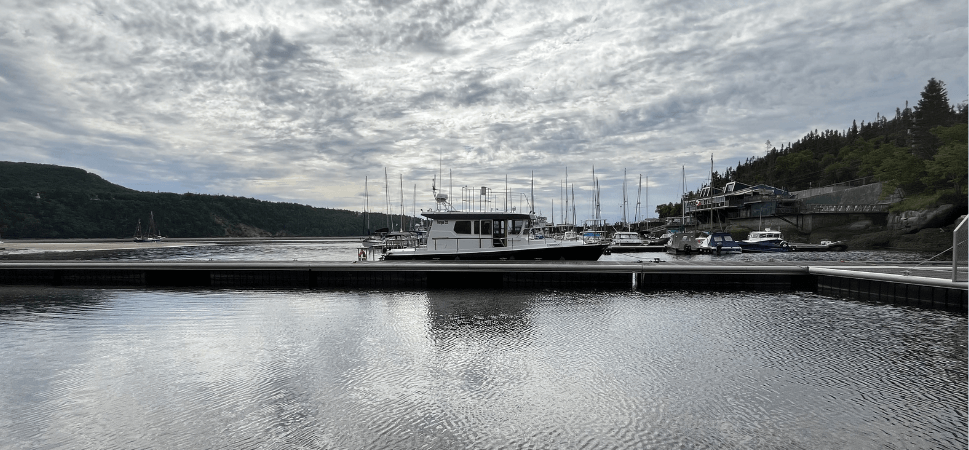
August 20, 2025. This morning, the Large Rorqual Project team is gathered on the docks of Tadoussac’s marina. We slip on our hats, gloves, and “Mustangs,” the colourful dry suits so essential to staying comfortable on the water. Later, we say goodbye to our colleagues from the St. Lawrence Beluga Project, who are departing for a day aboard the Antarès just as we prepare to board the BpJAM. I’m accompanied by Laurence, today’s captain; Janie, who’s been tasked with photo-identification; and Mathieu, who will be operating the drone.
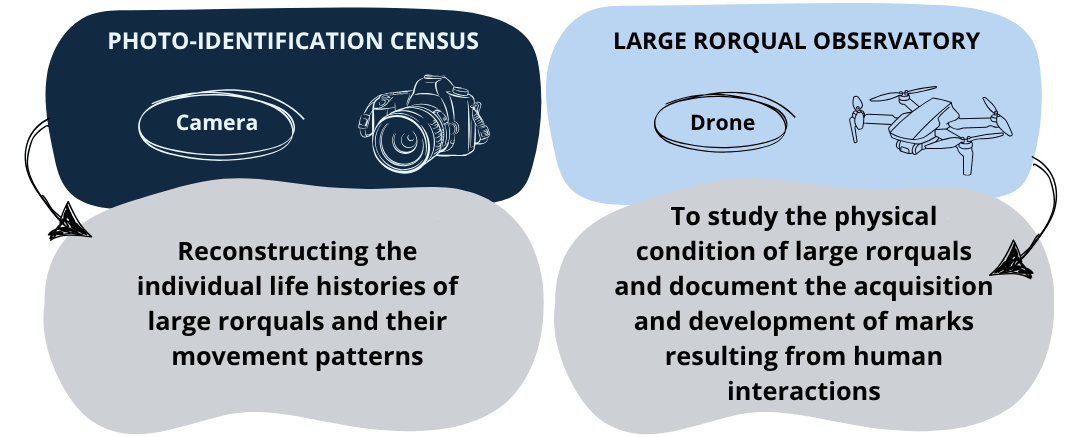
Since 1985, the Large Rorqual Project team has been carrying out long-term monitoring of large rorquals (namely blue, fin, and humpback whales) that frequent the St. Lawrence Estuary in order to better understand their habits and explore ways to co-exist with them. The project has recently been divided into two components: the photo-identification census and the Large Rorqual Observatory, the latter aiming to collect data on the physical condition of individual whales.
Team in scanning mode!
Like any research team, the Large Rorqual Project team follows a rigorous protocol for each of its trips into the field. This protocol helps inform decisions about the route to take and ensures consistency in the data collection process. For subsequent analysis of the results, it is essential that the data collection method be the same from one trip to the next. Otherwise, it’s like comparing apples and oranges! What defines science is a consistent and unbiased approach. Science cannot exist without a protocol and a well thought out method that can be replicated on every outing.
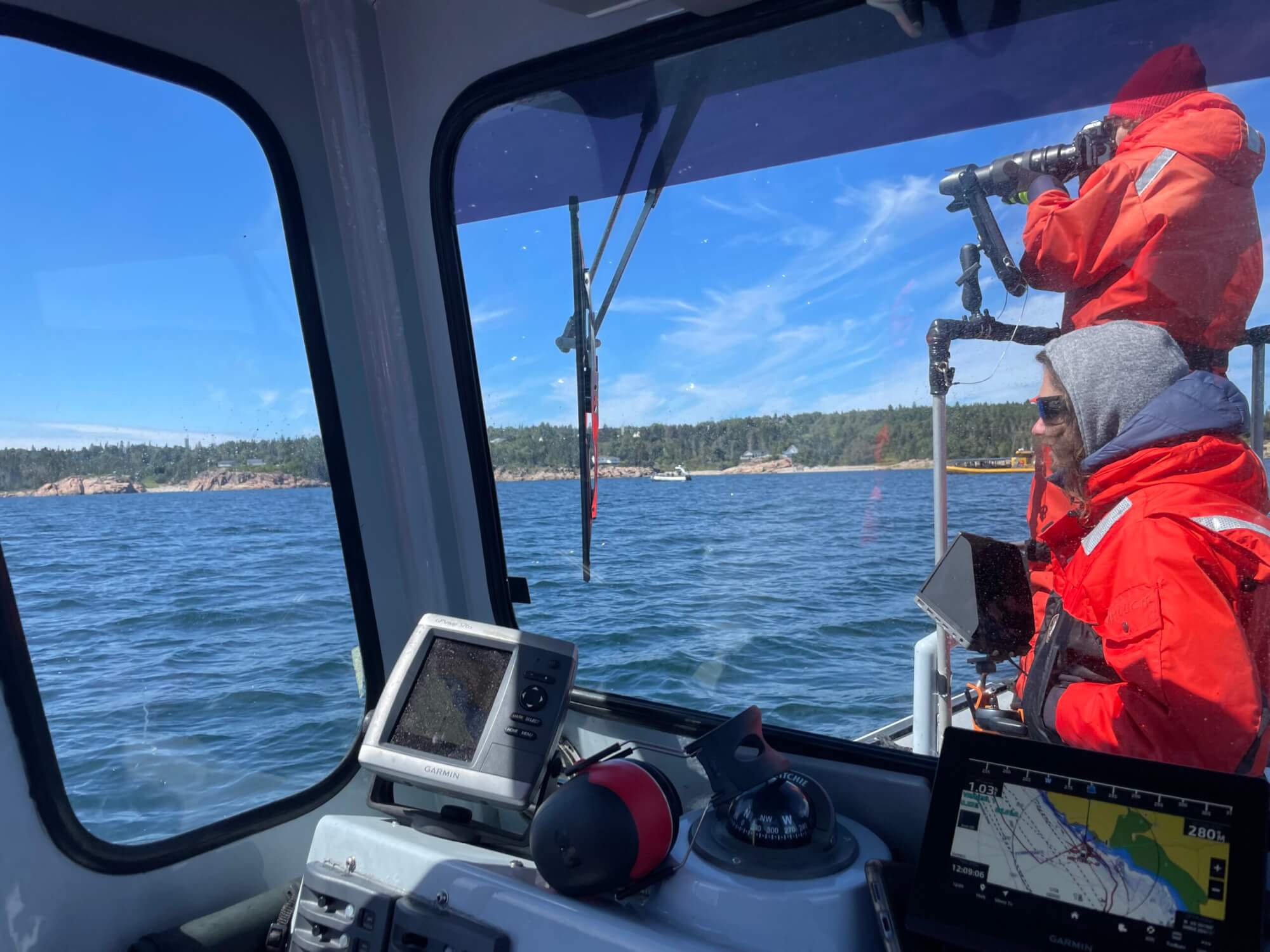
The GREMM team’s protocol for counting fin whales consists primarily of following transects (precise routes) on the water and stopping at various pre-established strategic points to log their observations. There are 13 pre-determined points covered by the team in this section of the Lower Estuary. Thirteen points means thirteen observation stations. Each observation station lasts 10 minutes and begins as soon as Laurence brings the inflatable boat to a stop. At this point, Janie climbs onto a platform at the bow of the boat and starts taking note of any ships, kayaks, cargo vessels, and Zodiacs within a 2,000-metre radius. All this information is recorded in real time using an iPad. This saves a great deal of time for data processing once we’re back on dry land! Wind and wave conditions (among other parameters) are also noted at each station.
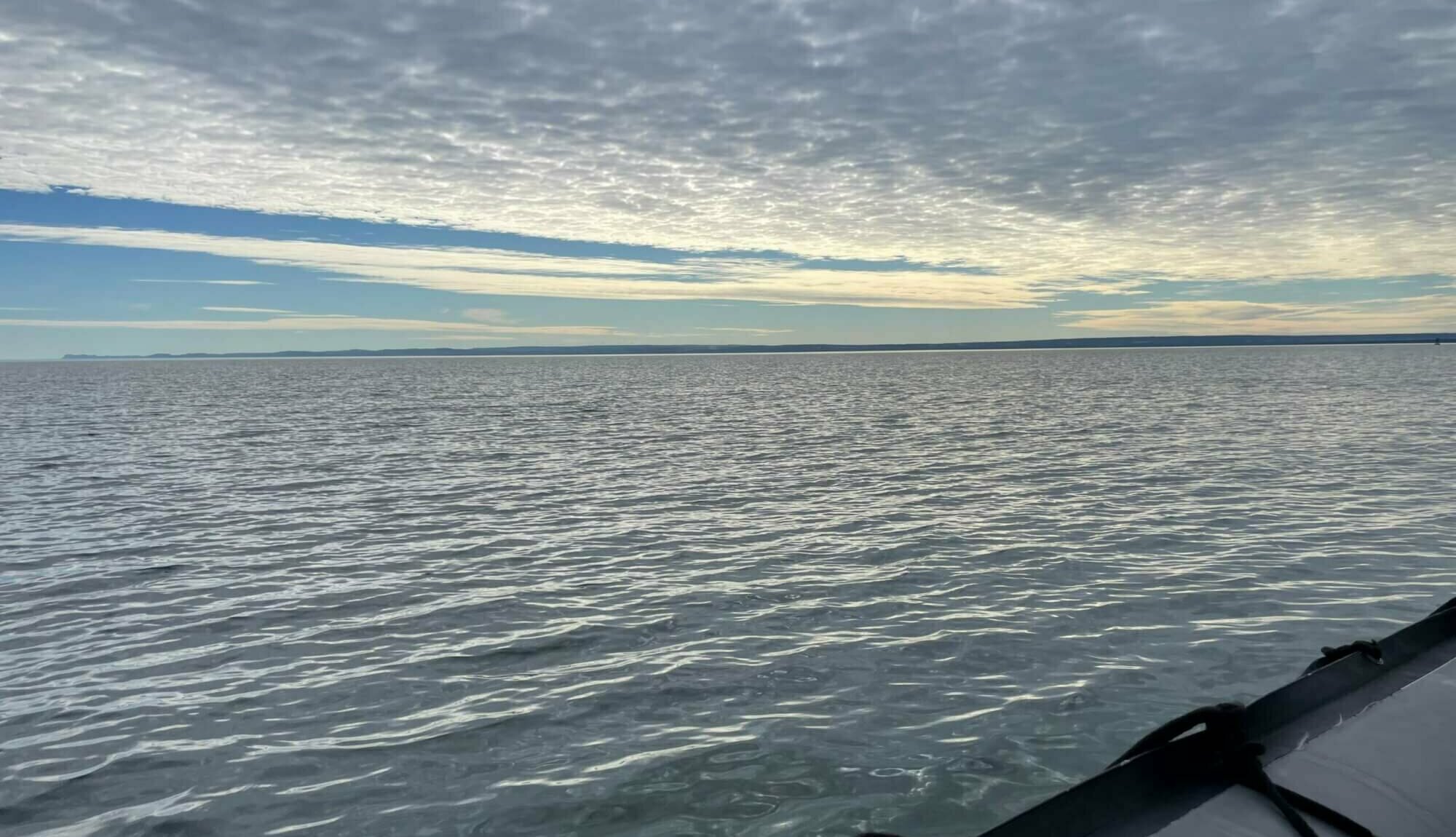
Then it’s time to tally all the marine mammals within the aforementioned radius. Everything counts, from harbour seals to blue whales!
- If a fin whale is spotted, we stop noting information at the station and slowly make our way toward it.
- The same principle applies if a spout is seen while travelling between two stations.
- If no animals are seen, we wait for the full 10 minutes to pass before heading to the next observation station. The absence of any large rorquals is significant data in itself!
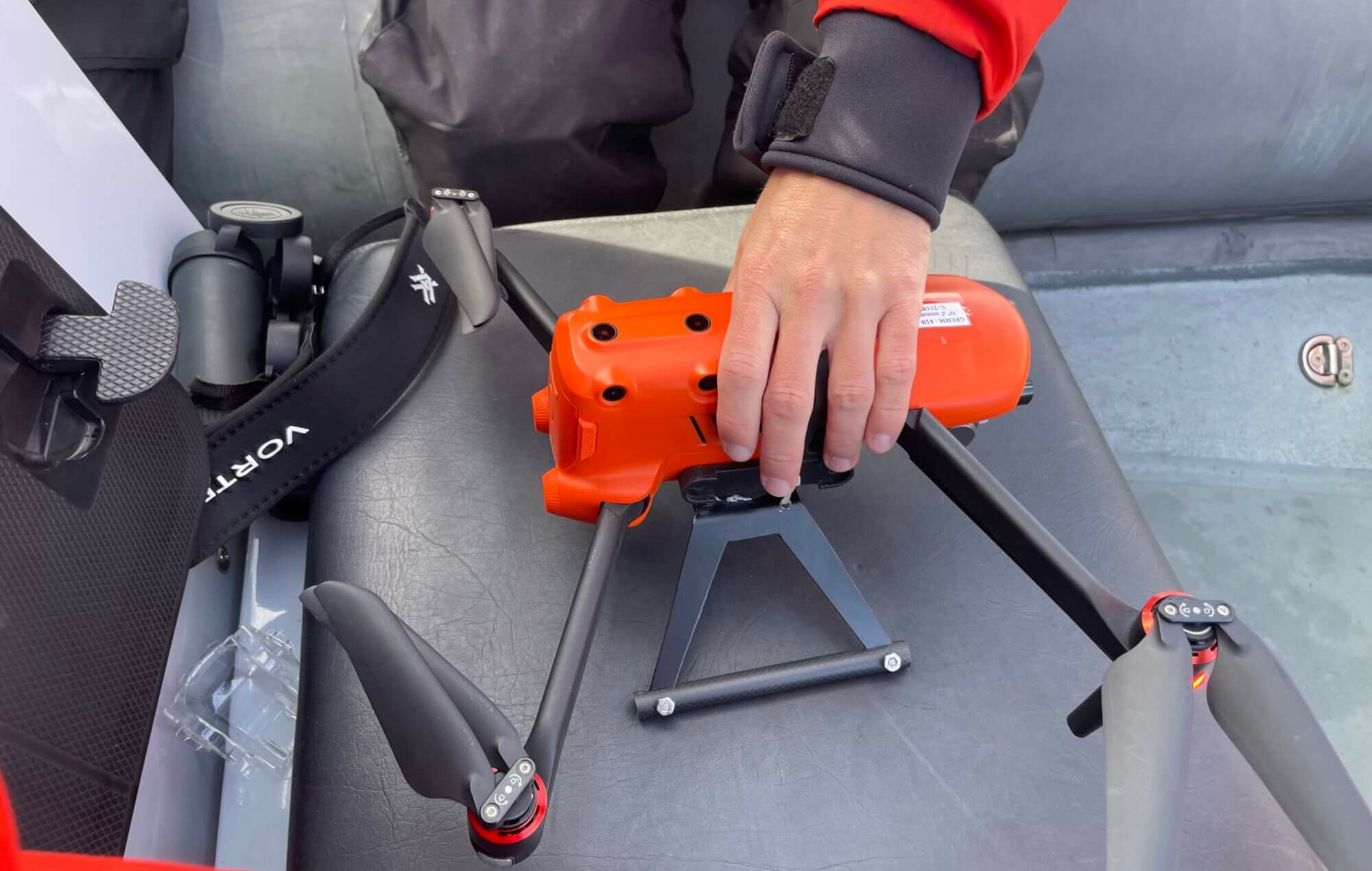
Once it gets close to a humpback, the BpJAM comes to a stop: Time to get out the camera and the drone! While Laurence attempts to position the craft at an optimum angle for photos, Janie gets the camera ready and Mathieu deploys the drone’s arms and propellers.
Essential images
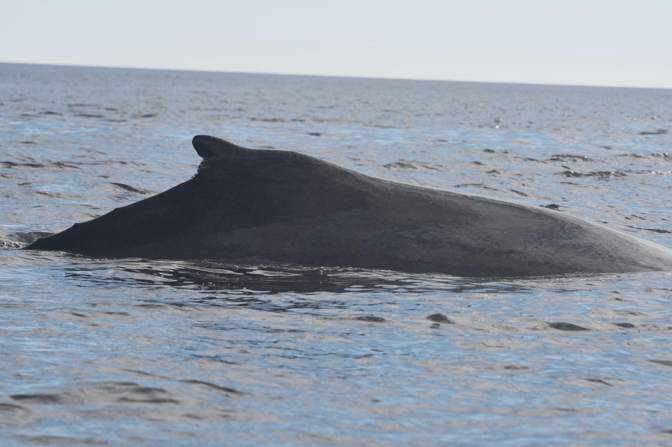
The drone will be used to capture aerial images of the animal, potentially to assess its physical condition and the presence of marks caused by interactions with human activities. These images will also be used to identify individuals, but from the air! Meanwhile, the camera is used to capture the flanks and fins of large whales passing through the St. Lawrence for the season. These images will be added to the catalogue managed by the GREMM (Group for Research and Education on Marine Mammals), which allows researchers to compare the year-to-year evolution of individual markings and colour patterns, with the goal of reconstructing the stories of these giants of the sea. To date, this catalogue contains the profiles of 149 humpbacks, 161 fin whales, and 110 blue whales.
Teamwork
Sometimes the research team finds itself working at sites frequented by whale-watching cruises, as was the case during the encounter with H859 not far from the ferry terminal in Les Escoumins. The tour boats already present before the arrival of BpJAM have been sharing information on the animal’s behaviour on Channel 8 of the VHF marine radio. The research team takes this opportunity to share its observations of the day and the area covered. The BpJAM team uses the same channel to notify the boats of the drone’s takeoff. Camera and drone are then deployed as they were earlier with the humpback whale H943, which was encountered farther offshore this time while sailing between two stations.
The best way to spot a fin whale is to catch sight of its powerful blow as it surfaces to breathe. A little experience and a sharp eye make it easy to notice the wisps of condensation rising above the water. Experts can even identify the species simply based on the shape of the spout. And then we start all over again with a drone launch and a photo shoot!
The team doesn’t always visit all 13 stations in a single day. Worsening weather conditions due to wind and waves sometimes make approaches much more difficult and drone flights simply impossible!
Back at the dock around 3 p.m. with drone and camera footage of two humpbacks, we were able to cover two-thirds of the survey area before the wind picked up!

Learn more

Odélie Brouillette
Odélie Brouillette joined the GREMM team as a writer and naturalist in 2022, and has been a project manager in scientific communication since 2023. With a background in biology, she loves learning and sharing with others what's most important to her. She has always been fascinated by marine environments and whales, and hopes to contribute to their protection through awareness-raising and popularization.
Recommended articles

Protecting Whales, One Conversation at a Time
As the beluga calving season in the St. Lawrence enters into full swing, so too do public awareness efforts. For…
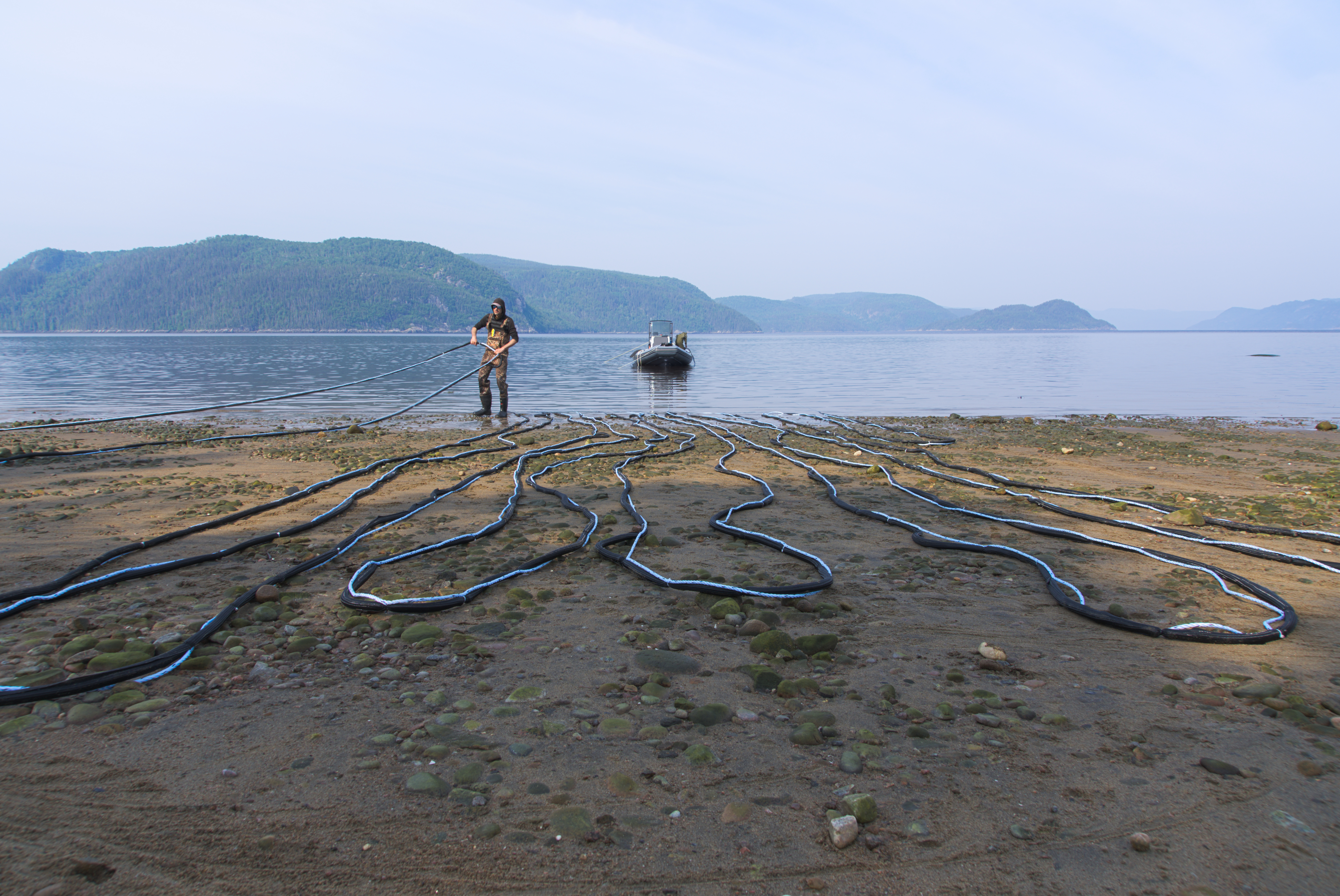
Listening to Belugas by Hydrophone in Baie-Sainte-Marguerite
After several months of preparations, the Window on Belugas project has just reached a new milestone in Baie-Sainte-Marguerite thanks to…
Over the years…
July 7, 2025: It’s early in the morning, and I'm waiting for news from the research team. Will weather conditions…